

Does Google contradict itself? Descriptive URLs and internal links
Google recommends understandable URLs while stressing internal links. A contradiction? We check the sources and explain why URL depth is not click depth.
Google advice, fact-checked · Part 1
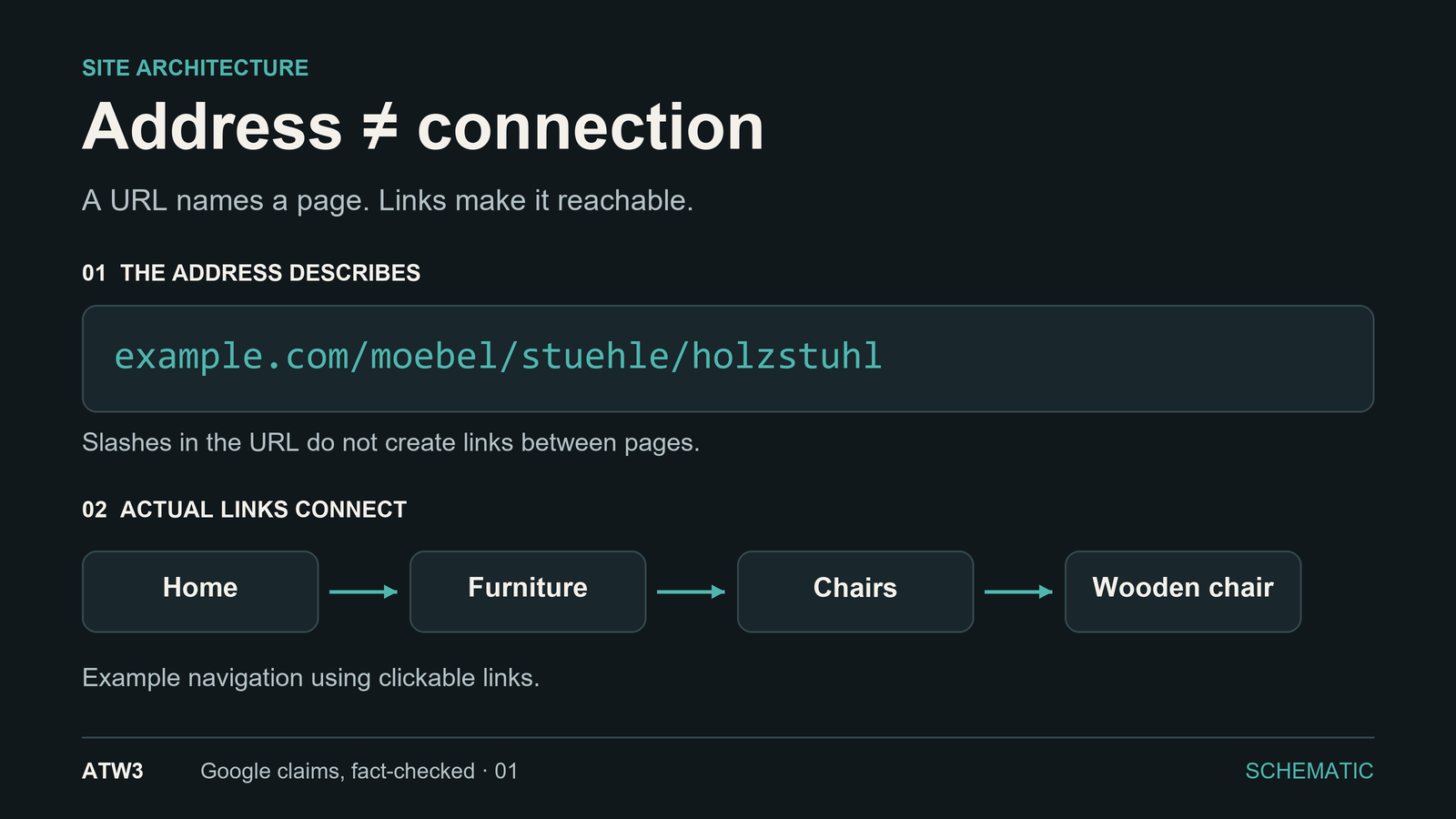
Google recommends understandable URLs. At the same time, it describes internal links as a basis for understanding relationships and the relative importance of pages. Why use /furniture/chairs/wooden-chair if slashes alone do not create a website hierarchy?
It is a fair question, but not evidence of a contradiction. Three things need separating: a page's address, its actual connections and its relevance to a search query.
In this article
What Google actually recommends for URLs
What internal links contribute
A shop example: URL depth is not click depth
A contradiction, or two different questions?
What this means for SEO practice
Conclusion
What Google actually recommends for URLs
Google Search Central recommends simple, logical URL structures with readable words instead of obscure identifiers. Unnecessary parameters should be removed where possible. It does not establish a general rule that shorter URLs rank better. “Short and memorable” is practical design advice, not a proven ranking promise. Source: Google's URL structure guidance.
For example, /furniture/chairs/wooden-chair provides more orientation than /item?id=8472. That makes the first address easier to understand. It does not prove that the second must rank worse.
What internal links contribute
Google's ecommerce documentation explains how connections between pages help it understand a website. The number of link steps required and the number of incoming links can indicate a page's relative importance within that site. Its recommendation is to actually link categories, subcategories and products together. Source: Ecommerce website structure.
“Relative importance” is not the same as “best match for a search query”. Google describes many ranking systems and signals, including link analysis and PageRank. More internal links alone therefore do not guarantee a higher position. Source: Google's ranking systems guide.
A shop example: URL depth is not click depth
Imagine a furniture shop with a product at example.com/furniture/chairs/wooden-chair. Navigation leads from Home → Furniture → Chairs → Wooden chair. That is three link steps, assuming this is the shortest available route.
The homepage now receives an additional, useful link directly to the wooden chair, perhaps in a curated product selection. The URL remains unchanged. The shortest path from that starting point to the product is now just one link step.
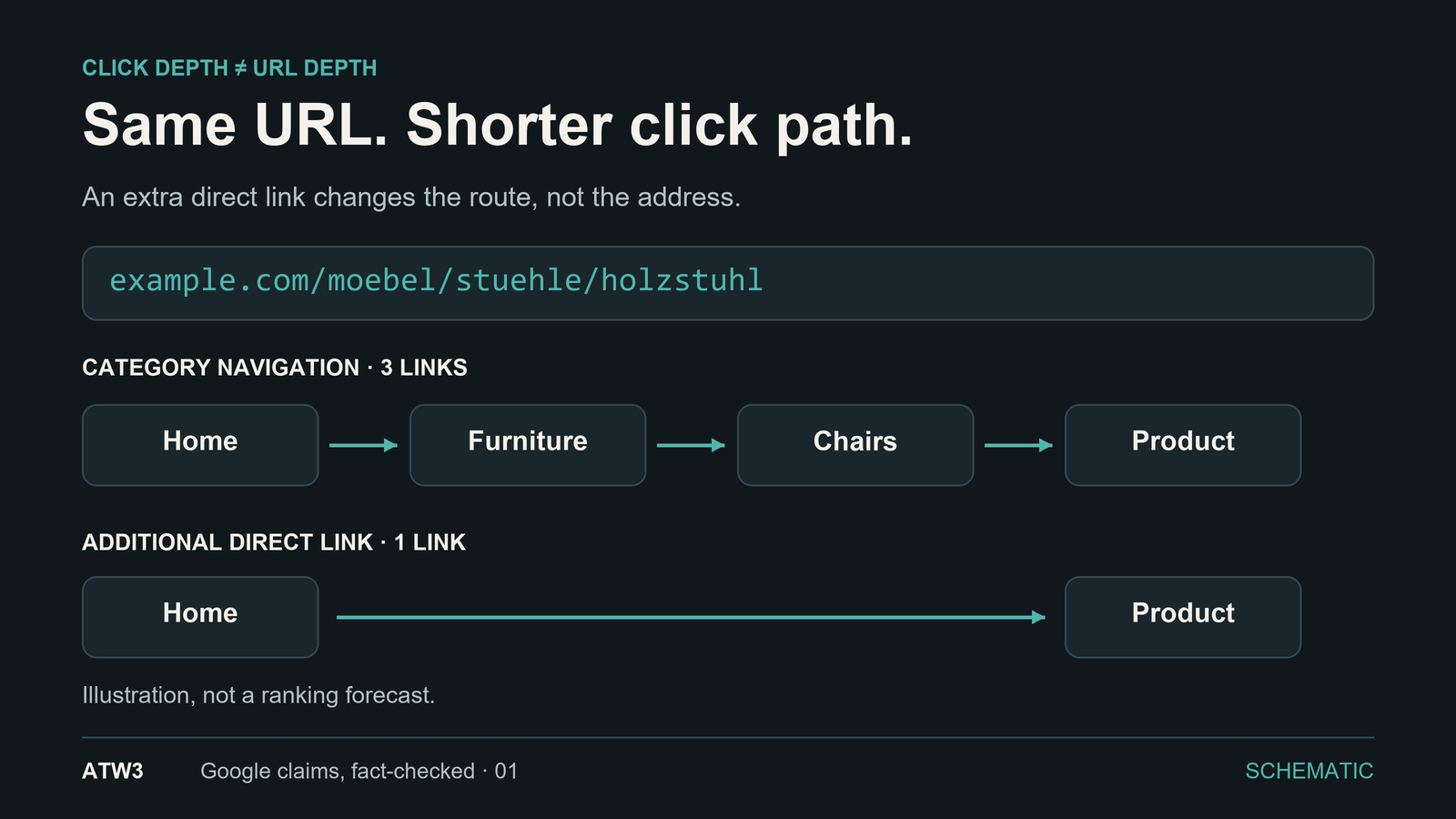
The reverse is also possible: a product at example.com/wooden-chair may only be reachable through several categories. A short address does not automatically shorten the actual click path. Likewise, an address containing category names does not replace links from those category pages.
A contradiction, or two different questions?
Our assessment: the recommendations complement each other. An understandable address answers “Which page is this?” Linking answers “How do I reach it, and how does it relate to other pages?” The mistake is turning advice about readability into an assumed ranking hierarchy based on URL length.
However, “Google completely ignores URL directories” would also be inaccurate. The SEO Starter Guide explains that grouping related content in directories on large sites can help Google learn update frequencies and plan crawling. That serves a different purpose from a blanket ranking bonus for folders. Source: Google SEO Starter Guide.
What this means for SEO practice
Keep addresses understandable and stable. As short as useful and as descriptive as necessary. Do not rebuild a working site solely because its URLs contain a few slashes.
Make important pages meaningfully reachable. Consider navigation, relevant categories and editorial cross-links together.
Link with context. Descriptive anchor text and surrounding text support understanding. Google specifies no magical ideal link count. Source: Google's link guidance.
Check URL depth and click depth separately. A crawl should examine orphan pages, actual connections and the chosen starting point, not just addresses.
Conclusion
The useful choice is not “descriptive URLs or internal links”. Good SEO combines understandable addresses with a coherent information architecture. Renaming folders alone does not create connections between pages. Adding as many links as possible does not automatically create good navigation.
This series examines apparently contradictory Google advice in its original context. When assessing a website, ATW3 therefore considers technical SEO and internal linking together.
Sources checked: 5 November 2026. All linked references are from Google Search Central. The shop examples and illustrations are our own explanations, not measured ranking experiments.